Your Audience Is a Content Goldmine (If You Know How to Ask)
Creators brainstorm in isolation. Their audience already knows what's missing. The gap is structural, not creative.

You probably have a content calendar with ideas you brainstormed in isolation. It's a reasonable list — you know your audience, you know what's worked, you know what you're good at. What that list can't contain is the thing your audience wished existed that you've never imagined, or the phrase they'd use to describe it that you'd never naturally think to type.
You can't brainstorm your way into someone else's head. That's the ceiling on solo content generation, and it's lower than most creators realize.
One open question, asked directly, opens a different source of raw material entirely. Not just ideas — language.
The ceiling on solo brainstorming
When you generate content ideas alone, you're working from your own perspective, your own experience, your own sense of what's interesting. That's not nothing — your instincts got you where you are. But your perspective has a ceiling. You can only imagine what you've imagined. You can't generate ideas from experiences you haven't had or questions you've never thought to ask.
Your audience has hundreds or thousands of perspectives, needs, and problems you've never encountered. They've tried things that didn't work. They've searched for explanations and found them lacking. They have questions that feel obvious enough to them that they've never seen answered — and feel too basic to ask in a comment section where other people might see.
The gap between what you could brainstorm alone and what your audience would tell you if you asked is almost always larger than creators expect. Not because your instincts are wrong. Because your instincts are yours, and your audience is made of people whose contexts you've never lived.
Language is the underrated asset
When someone answers an open question honestly, they're giving you more than an idea. They're giving you language.
The specific words they use to describe a problem, the way they frame what's missing, the analogy they reach for to explain their confusion — these are valuable in a way generic topic ideas aren't. Write a piece using the exact vocabulary your audience uses to describe their own problem, and it reads differently than a piece where you translate their problem into your own terms.
It performs differently in search, too. The phrasing someone types into Google when they're trying to solve a problem is usually closer to how they articulate it in a response than to how you'd naturally frame a title from the outside. Your audience has already written the better SEO metadata — you just don't have access to it until you ask.
Direct quotes become pull quotes. Recurring frustrations become series anchors. The specific analogies people reach for become episode framing. And the outlier response — the unexpected phrase that only one or two people used but captured something precisely — sometimes becomes the most interesting piece you'll make all quarter, because it says something nobody else was saying.
The co-creation effect
There's a specific thing that happens when a reader recognizes their own words in your work. Not plagiarism — reflection. A piece that so accurately describes what they said that they feel seen.
User-generated content flywheels tend to see 75% of content either created or directly informed by community members, with engagement rates over 2% and conversion rates over 4% — metrics that passive content delivery rarely matches. The mechanism is straightforward: people engage with things they helped create.
When you ask your audience a question, find the themes in what they told you, and publish something that reflects it back — you're not just doing research. You're creating shared ownership. The subscriber who described their struggle in a response and then sees it named accurately in your next piece didn't just read an article. They participated in something.
This changes the relationship. It changes the likelihood they share it. It changes how they feel about the next question you ask. Each cycle builds a little more of what most creators are trying to build and struggling to name: an audience that has a stake in the work.
The practical mechanics
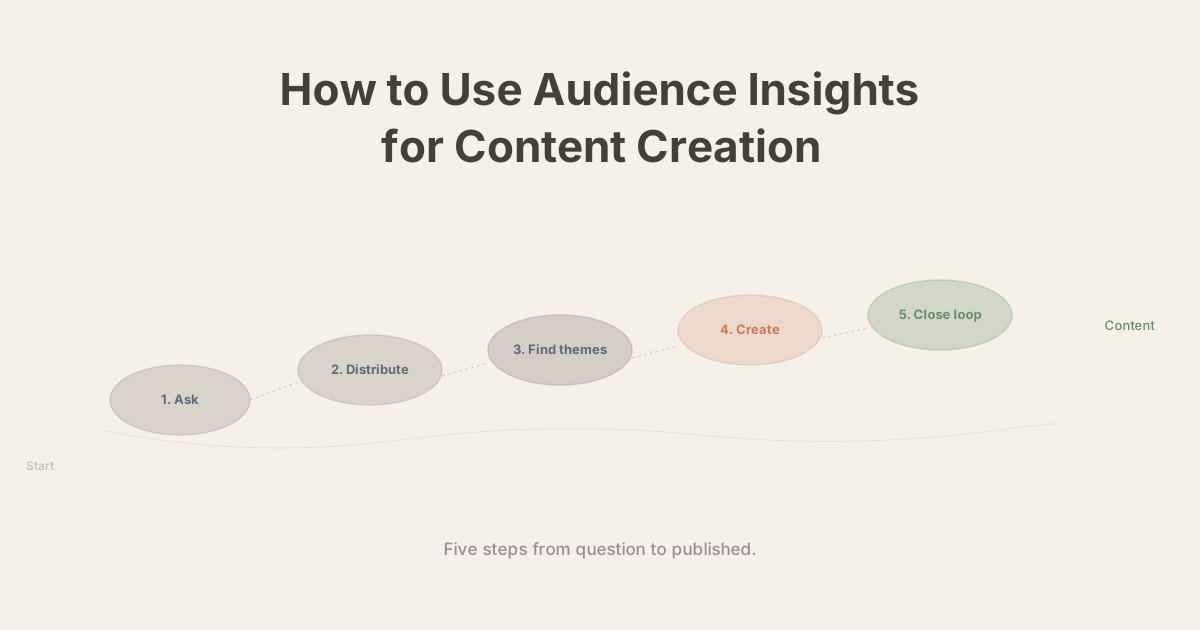
One question. Open text field. Send it to wherever your audience is most reachable — newsletter, show notes, pinned community post. Give it a week.
Read the responses — or if you have hundreds, use a synthesis tool that clusters for you. What came up multiple times in different words? That's your next piece. What came up once but was surprising or especially well-articulated? That might be the most interesting piece. What came up that you'd never have thought to write about? That's the ceiling-breaker — the content idea that could only have come from asking.
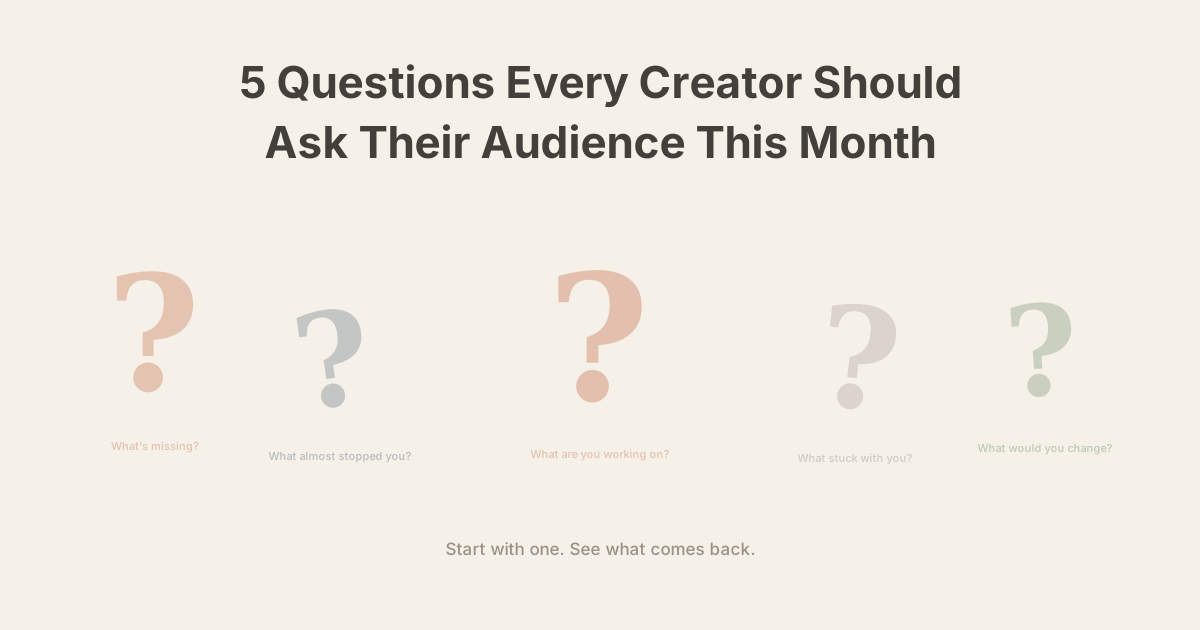
The questions that generate the richest content ideas are often the most direct:
"What topic in [your niche] does nobody explain properly?"
"What's something you keep trying to find that doesn't seem to exist?"
"What would you type into Google right now if you were trying to solve [problem]?"
These send your audience looking inward for gaps in what they've been given, rather than asking them to evaluate what you've already made. The responses aren't evaluations — they're raw material.
Some won't be usable. Some will be too niche, out of scope, jokes. That's fine. The signal you need is in the patterns — the things multiple people mentioned without coordinating. Those are real.
Closing the loop
The step most creators skip: tell your audience what you made from what they told you.
Not elaborate attribution. Just: "You told me this was missing. Here it is." A sentence in the introduction, a note in the newsletter, a mention in the episode. Something that closes the circle.
When your audience sees that responding to your questions changes what you make, they respond to the next one. Each cycle produces better raw material, better content, and a more invested audience.
The goldmine doesn't deplete. It deepens every time you use it.
Tags

Want insights like this for your audience?
Set it on autopilot. One question a week, every response analyzed into insights you can actually use.
Start free — no credit card