5 Questions Every Creator Should Ask Their Audience This Month
If you've never sent your audience an open-ended question — or it's been a while — start with one of these five.
AskEveryone
If you've never sent your audience an open-ended question — or it's been a while — here are five that work across creator types. Each takes thirty seconds to answer. Each tends to surface things your analytics never will.
Pick one. Ask it this week. Make it anonymous. Read what comes back.
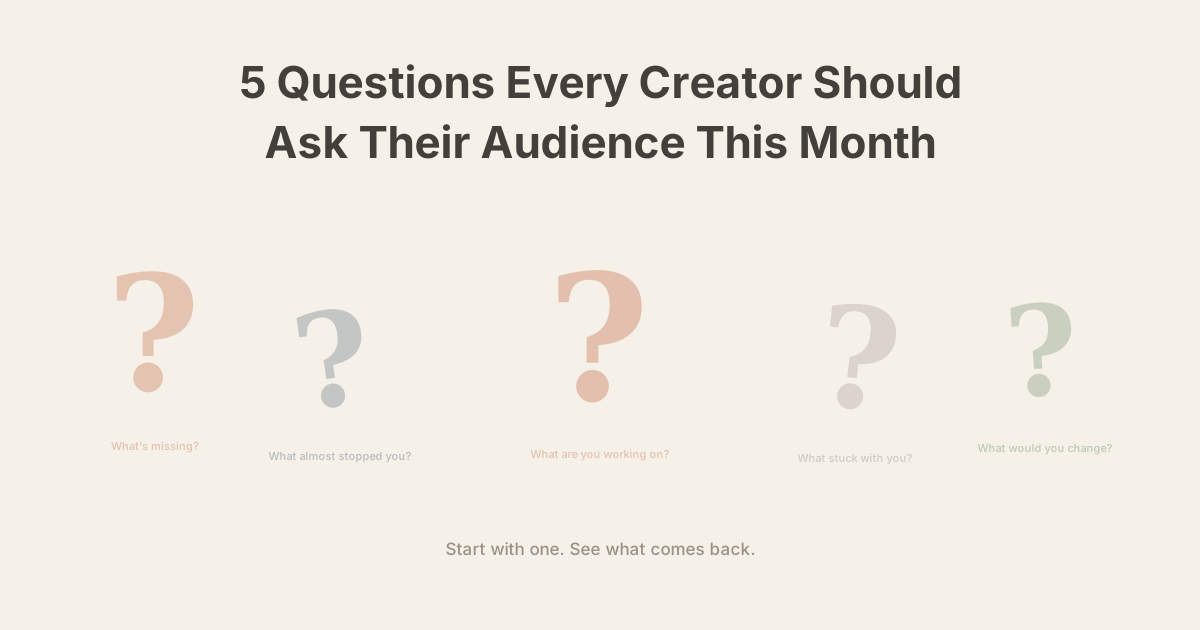
1. "What's the one topic in [your niche] that nobody explains properly?"
Why it works: It sends your audience looking for gaps — not evaluating what you've done, but searching their own experience for something missing. The responses are almost always actionable content ideas in your audience's own language, framed exactly the way they'd phrase a search query.
What to expect: Three to five recurring topics framed differently by different people. One or two things you've covered but apparently not clearly enough. Occasionally something you'd never have thought to cover that turns out to be the most-wanted piece you've ever made.
Best for: Content direction, title brainstorming, understanding gaps in your niche.
How to ask it: "I'm working on what to cover next. What's a topic in [niche] that you keep trying to find a clear explanation of and can't? No right answer — just what's been on your mind."
2. "What almost made you unsubscribe / stop watching / stop listening?"
Why it works: The hardest question to ask, and consistently the most useful. It surfaces friction points that are invisible from the inside — the thing that a meaningful percentage of your audience privately felt that almost changed their behavior. With a name attached, almost nobody answers this honestly. Anonymously, many people will tell you exactly what happened.
What to expect: Some responses will be external (life got busy, nothing to do with you). The ones worth reading are specific: a format change, a shift in tone, a topic that felt off, a frequency increase that felt like too much. Even one or two of these can change something important.
Best for: Retention, format decisions, understanding the experience of your audience rather than just the content.
How to ask it: "Honest question, and completely anonymous: has there been a moment when you almost stopped following this? If so, what was it? I'm genuinely trying to understand."
3. "What are you working on right now?"
Why it works: It meets your audience where they actually are, rather than asking them to speculate about your content calendar. The responses reveal who your audience is in practical terms — what they're building, struggling with, trying to figure out — which is the raw material for content that feels directly relevant rather than generally interesting.
What to expect: Enormous variety, which itself is useful data about the range of your audience. Look for the clusters — the things that multiple people are working on independently. Those clusters are where the highest-demand content lives.
Best for: Understanding your audience's current context, finding tutorial and how-to content ideas, personalizing future questions.
How to ask it: "I'm curious about what's actually going on in your life right now. What are you working on — personally or professionally — that you're most focused on?"
4. "What's something I said that stuck with you?"
Why it works: It shows you the gap between what you think resonated and what actually resonated. The throwaway observation you made in passing, the example you used to illustrate something else, the aside you almost cut — these are often what people remember. The responses recalibrate your sense of what matters.
What to expect: Surprising specificity. People remember exact moments, often from months ago. The things they cite often aren't the things you'd have predicted. This question is less about content direction and more about understanding your voice — what in your work has actual impact beyond what you're measuring.
Best for: Understanding your distinctive value, refining what you emphasize, calibrating your editorial instincts.
How to ask it: "I'm curious what's stayed with you. Is there something I've said — an episode, an issue, a video — that you've thought about since? What was it?"
5. "If you could change one thing about [your content/newsletter/podcast], what would it be?"
Why it works: "One thing" forces prioritization. Without that constraint, you get laundry lists that are hard to act on. With it, you get the single most salient improvement from each respondent's perspective — and when those converge across many responses, you have a genuine priority.
What to expect: More constructive criticism than you'd get in any other format. Anonymity makes this safe to answer honestly, and the "one thing" framing makes it manageable to give. Look for the thing multiple people mention without prompting — that's the signal worth acting on.
Best for: Format decisions, quality improvement, understanding where your current approach has gaps.
How to ask it: "If you could change one thing about [the show/newsletter/channel] — format, frequency, topics, length, anything — what would it be? No need to be diplomatic, anonymous responses only."
A note on sharing what you hear
Whichever question you ask: tell your audience what you heard. Not attribution (anonymity is the point), but a summary of the themes. "I asked what topics were missing — here's what you told me." "I asked what you'd change — here's what came up most."
Closing the loop is what turns a one-time ask into an ongoing relationship. It signals that responding was worth it — that something happened because of what people said. That's the signal that makes your next question get answered more readily.
Start with one. See what comes back. Then ask again.
These questions work for podcasters, YouTube creators, and newsletter writers. Adjust the framing to fit your format — the principle holds across all three.
Tags


Want insights like this for your audience?
Set it on autopilot. One question a week, every response analyzed into insights you can actually use.
Start free — no credit card