How to Write a Question That Gets Thousands of Responses
The difference between 12 responses and 1,200 isn't reach or timing. It's the question itself.

You've probably sent a question to your audience that got almost nothing back. Not because your audience was disengaged — because the question didn't invite a response.
The difference between a question that generates two replies and one that generates two hundred isn't reach, or timing, or how well you promoted it. It's the question itself. Specifically: whether it gives the reader something to hold onto, or whether it slips past them before they can think of what to say.
This is learnable. Most of it comes down to a few patterns that show up consistently in questions that work and fail in the ones that don't.
The sweet spot: specific enough to answer, open enough to surprise
Questions that generate the highest response rates and the richest answers live in a narrow zone. Specific enough that someone immediately knows what territory they're being asked about. Open enough that they can bring their own experience to it, instead of searching for the correct answer.
"What are you working on?" is too wide. A hundred things come to mind. The question dissolves before they can answer.
"Did you enjoy our last episode?" is too closed. The answer is yes or no. Even if it's yes, there's nothing else to say.
"What's the one thing about [topic] that took you years to figure out?" is specific — it locates the question in a particular kind of experience — and open, because the answer is theirs, not yours. Nobody knows the correct response. They can only tell you their story.
The constraint creates the response. "One thing" forces prioritization. "Took you years to figure out" gives them a frame — they're not being asked to evaluate your content or rate their experience. They're being asked to remember something.
Questions that discover vs. questions that confirm
There are two types of questions most creators ask, and only one of them tends to produce useful answers.
Confirming questions: "Did you like the new format?" "Was this useful?" "Would you recommend this to a friend?" These feel like feedback, but they're asking your audience to evaluate something you've already done against criteria you've already set. The answers are usually predictable, and they confirm or deny what you already suspected. The ceiling on what you can learn is bounded by what you already think.
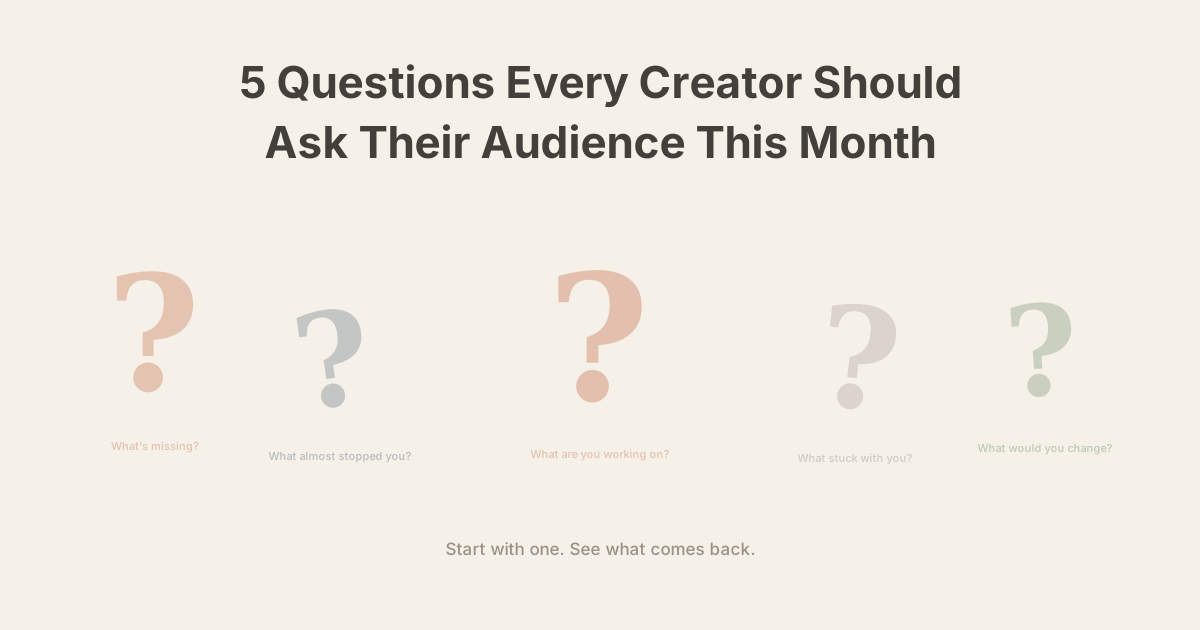
Discovering questions: "What topic do you wish someone would explain properly?" "What almost made you stop following me?" "What are you embarrassed to still not understand?" These open territory you haven't mapped. The answers can surprise you. They often do.
The best feedback you'll ever get is the answer to a question where you genuinely don't know what they'll say. If you could predict most of the responses before you sent it, the question wasn't really a question — it was an expectation disguised as one.
Five patterns that consistently work
A few specific structures show up repeatedly in questions that generate both high volume and useful responses.
"What's the one thing..." — The word one does real work. It removes the paralysis of open-ended infinite possibility and forces prioritization. "What's the one thing you're most confused about in [topic]?" is easier to answer than "What are you confused about?" — same question, narrower entry, same open terrain.
"What would you change about..." — Invites criticism without asking for criticism directly. "What would you change about how I cover [topic]?" gives people permission to say the uncomfortable thing. Framed as speculation rather than judgment, it reduces the social cost enough that people will answer honestly.
"Tell me about a time when..." — Triggers narrative. People are wired to tell stories. A question that gives them a story structure will get longer, richer responses than almost anything else. "Tell me about a time when [topic] went badly" gets paragraphs. "Have you ever had a bad experience with [topic]?" gets yes or no.
"What do you wish I knew about..." — Opens unexpected territory by signaling curiosity and implicit humility. "What do you wish I knew about being a first-time [creator type]?" gives permission to challenge your assumptions. The responses often reveal blind spots you didn't know you had.
"What are you struggling with right now?" — Creates immediate relevance. It meets people where they are, not where you imagine them to be. The responses are topical, specific, and usually actionable — you can make something from them directly.
What kills a question
Three things make an otherwise good question perform badly.
Too many questions at once. Ask three things in one send and you'll get one-third of the engagement on each, and nothing coherent to act on. Pick the question you most need answered. Ask only that one. The rest can go next week.
Rating scales where a question would work. "On a scale of 1-10, how satisfied are you with..." tells you a number and nothing about why. Replace the scale with a question: "What's one thing that would make this significantly better?" The qualitative answer is almost always more useful than the quantitative one.
Implied correct answers. "Don't you think [topic] is really important?" is not a question — it's a statement looking for agreement. Your audience can tell the difference, and it reduces response rates because there's no real space to answer honestly.
The iteration effect
Questions improve with practice. Your first few will be too broad, or too narrow, or too leading. That's normal. The pattern emerges over time: you notice which questions generated rich responses and what they had in common. You notice which fell flat and why.
Creators who ask regularly tend to develop this instinct within four to six weeks. Their questions in week one are usually fine but generic. By week six, they're asking things their audience has been waiting to answer — questions that feel personal without being intrusive, specific without being narrow.
The only way to get there is to start. Send the first question this week, even if it's imperfect. Read what comes back. Adjust the next one based on what you saw.
That's the whole craft. The rest is practice.
Tags

Want insights like this for your audience?
Set it on autopilot. One question a week, every response analyzed into insights you can actually use.
Start free — no credit card