The Weekly Ritual That Builds Superfans
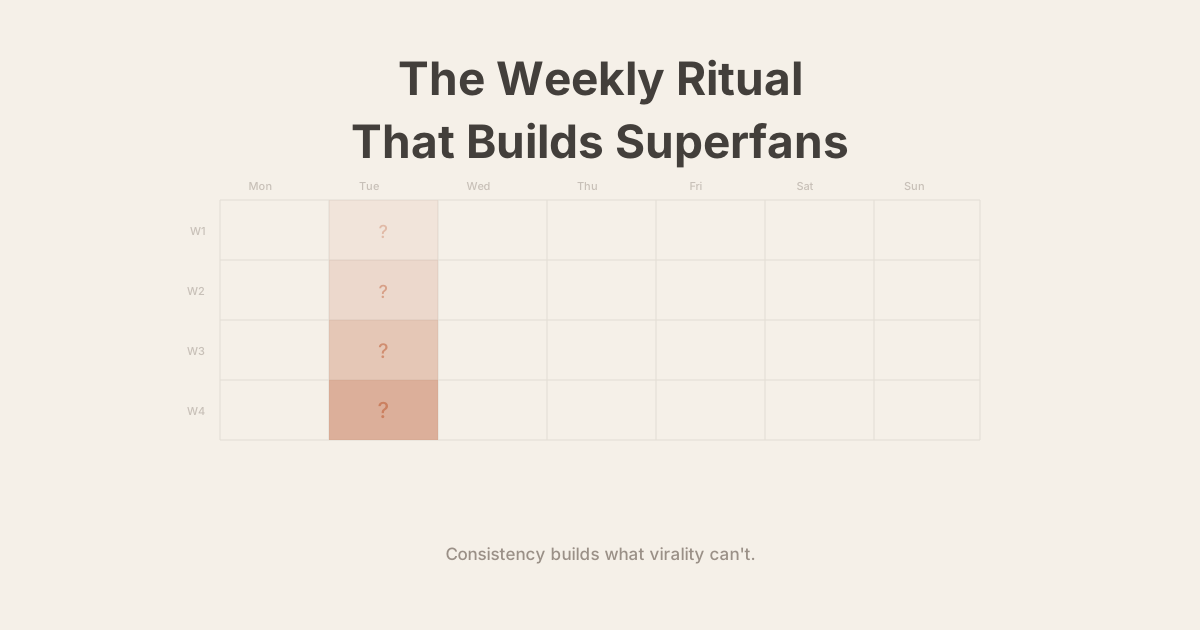
Viral content brings people in. Ritual keeps them. 90% of weekly engagers are still there after a month vs. 23% of non-engagers.
AskEveryone
Think about the creators whose work has mattered most to you. Not the ones you discovered and binged once, but the ones you've been following for years. The ones you'd notice if they stopped.
What made those relationships stick? It's rarely a single piece of content, however good. It's usually the accumulation of something — a consistent presence, a recurring exchange, the sense that the work is part of a rhythm you've come to rely on.
Most creators understand this at the level of publication schedule. Show up consistently, and people develop the habit of showing up for you. What fewer creators have built is the other half of that rhythm: a regular moment where the audience participates, not just receives.
That's the difference between an audience that follows and one that stays.
Why consistency builds what virality can't
Viral content brings people in. Ritual keeps them.
A piece that spreads widely gives you a moment — a spike in new subscribers or viewers who found you through something that landed. Whether those people stay depends on what they find when they arrive, and whether the experience gives them a reason to return.
Research from Braze found that 90% of people who engage with content weekly in their first month are still engaged after that month — compared to 23% of people who don't engage consistently in the first four weeks. The difference is striking. It's not about the quality of the individual piece. It's about whether the audience develops a habit of returning.
Habits form through repetition. Same trigger, same response, same reward. What builds audience loyalty isn't a great piece of content — it's the expectation of a great piece of content, reliably, on a schedule people have come to count on.
What participation adds to frequency
Publishing consistently builds the habit of consuming. Adding a regular question builds something different: the habit of participating.
There's a psychological shift that happens when an audience member responds to a question and then sees that response reflected in the creator's next piece. They didn't just consume — they contributed. The relationship is no longer purely one-directional.
This maps cleanly onto Duhigg's habit loop: a cue (the question arrives on the usual day), a routine (responding), a reward (the loop closes — the creator shares what they heard, something changes). When this cycle runs consistently, participation compounds. The first response is cautious, brief. By the third or fourth, people write paragraphs. By the sixth, the same people are your most active respondents, your sharpest critics, and your most reliable advocates.
The habit of participating in something is qualitatively different from the habit of watching something. It creates investment that passive consumption doesn't.
Weekly works for a specific reason
Daily is too frequent — it becomes noise, each ask losing value because there's always another one coming. Monthly is too infrequent — it never becomes a habit, each instance feeling isolated rather than part of a rhythm.
Weekly is the sweet spot because it maps onto the natural cadence of most creators' publication schedules and most people's information rhythms. Newsletters sent weekly are the strongest driver of habitual readership — not because weekly is a magic number, but because it's frequent enough to build expectation and infrequent enough that each issue still feels like an event.
The same principle applies to audience questions. A weekly question that people come to expect — that arrives as reliably as the episode or issue it accompanies — becomes part of the experience of following you. Not an add-on, but part of what showing up for your work means.
What compounds
The most immediate return from a regular question practice is content ideas and audience understanding. Both are valuable from week one.
What takes longer to notice is the relational compound effect. Response rates tend to increase over time — not dramatically in the first few weeks, but steadily over months. Response quality improves: early answers are brief and careful, later answers are longer and more honest. The audience learns that responding is worth the effort because something happens with what they say.
More importantly, the people who respond consistently become invested in your work in a way that passive audience members aren't. They've been part of the process. They've shaped things. When you make something, they want to see how it turned out. When you ask the next question, they answer faster.
This is the foundation of what most creators call superfans — not people who love a piece of content, but people who have a stake in the work. That stake is built through participation, not exposure.
Building the ritual
The mechanics are simple: pick a day, pick a channel (email, show notes, community post), ask one question, share what you learned before asking the next one.
AskEveryone was built around this weekly cadence — one question, anonymous responses, synthesis that surfaces the themes. But the principle works with any tool. What matters is the consistency: same day each week, same mechanism, same follow-through. The ritual becomes recognizable. Recognizable things get returned to.
The first week, you'll probably get a handful of responses. The tenth week, more. The twentieth, the people answering are the core of your audience — the ones who follow closely enough to have opinions, engaged enough to share them, invested enough that they've become something more than subscribers.
That's not a funnel. That's a relationship. And it's built one question at a time.
Tags
Want insights like this for your audience?
Set it on autopilot. One question a week, every response analyzed into insights you can actually use.
Start free — no credit card