Anonymous Feedback Builds Trust (Here's Why)
Removing someone's name should make feedback less trustworthy. In practice, the opposite is consistently true.
AskEveryone
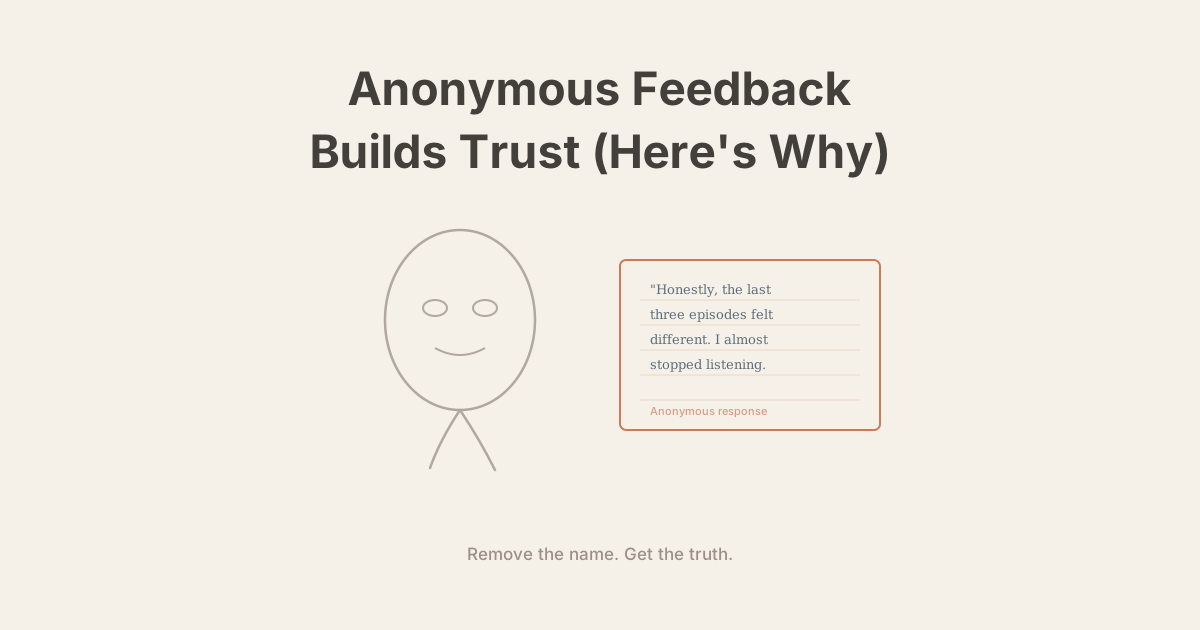
It seems counterintuitive. Removing someone's name from their feedback should make it less trustworthy — harder to verify, easier to dismiss, unattributable to any real relationship.
In practice, the opposite is true. Anonymous feedback is more honest, more complete, and more useful than identified feedback. The research on this is consistent across contexts — workplace surveys, product feedback, academic research — and the mechanism isn't mysterious once you understand it.
When someone knows their name is attached to what they say, they calibrate. They consider who will read it, what those people will think, how it reflects on them, whether the candid thing they want to say is worth the social cost of saying it. The result isn't dishonesty, exactly — it's self-editing. The response represents what they're willing to say publicly, which is a specific and limited version of what they actually think.
Remove the name, and most of that calculation disappears.
What the research shows
The data on anonymity and honest response is consistent across a range of settings.
University of Michigan research found that anonymous surveys generate 40-60% more honest responses than those tied to identifiable data. 71% of people say they're more likely to share their true feelings when they know their identity is hidden. Organizations running anonymous feedback mechanisms see up to 58% more truthful responses than those that don't.
The effect shows up most dramatically around constructive criticism and uncomfortable observations. When anonymity is assured, the rate at which people report problems or raise concerns jumps from 36% to 62%. The feedback that's hardest to give with a name attached is precisely the feedback that's most valuable to receive.
For creators, this translates directly. The subscriber who thinks your recent content has drifted from what made you worth following won't say that as a reply to your email — where you'll know who said it and the relationship might shift. They will, often at length, say it in an anonymous text box where the social cost is zero.
The performance cost of identified feedback
When your name is on something you say, you're not just communicating — you're performing. The response has to represent you accurately to the person reading it. It has to fit within the relationship. It can't undermine other things you've said or create new obligations you're not prepared for.
Sociologist Erving Goffman described public interaction as impression management: we present the version of ourselves appropriate to the audience, adjusting constantly based on context. This isn't dishonesty — it's how social interaction works. But it means identified feedback is always shaped by the social context in addition to the content of the question.
The person who would write "your last three episodes felt like they were made for your critics, not your listeners" as an anonymous response won't write that with their name attached. Not because they don't mean it, not because it isn't useful to hear — but because saying it publicly, to someone you follow and respect, changes the relationship in ways the average listener doesn't want to navigate.
Anonymous feedback removes the performance requirement. What comes back is what the person would say if they were talking to themselves about your work.
What anonymity enables for creators specifically
The feedback most useful to creators is often the kind that's hardest to give with a name attached: honest assessment of what's not working, what's missing, what's changed for the worse, what the creator keeps getting slightly wrong.
Positive feedback is relatively easy to give publicly. People will leave glowing reviews, write kind replies, post appreciation on social media — because those responses are socially rewarding. They signal taste and loyalty to everyone who sees them.
Critical or nuanced feedback is different. "I've been listening for two years and the last six months have felt different" is a complicated thing to say to someone's face, or in any context where they'd know who said it. It carries social risk. It might change how the creator thinks about you. It requires more courage than most subscribers will spend on a feedback form.
Anonymous, it's easy to say. And it's far more useful than almost anything in your comment section.
What anonymity doesn't do
It's worth being honest about the limitation. Anonymous feedback has the same self-selection problem as all feedback: you're hearing from the people who chose to respond, not your whole audience. Anonymity improves the honesty of responses from people who respond. It doesn't solve the problem of who decides to respond in the first place.
It also doesn't eliminate all social shaping. Some people give nicer feedback anonymously than they actually mean, and some give harsher feedback because the social consequence has been removed. Most feedback lands closer to honest than either extreme — but interpreting it still requires judgment.
The point isn't that anonymous feedback is perfect. It's that it's systematically more honest than identified feedback, and that the difference matters most for the kinds of feedback creators most need to hear.
How we approach this
At AskEveryone, responses are detached from identity at the moment of submission. Not "anonymous but we could reconstruct it" — actually anonymous. The connection between a response and the person who gave it doesn't exist after submission. Even the creator can't trace who said what.
We built it this way because anonymity that can be reversed isn't really anonymity — it's deferred surveillance. And feedback collected under deferred surveillance isn't really anonymous feedback; it's feedback shaped by the knowledge that anonymity is conditional.
The result is that responses tend to be more candid, more specific, and more useful than what the same audience would say in a public channel. Not because people are cruel when unobserved — but because they're honest.
Tags
Want insights like this for your audience?
Set it on autopilot. One question a week, every response analyzed into insights you can actually use.
Start free — no credit card