7 Reasons Open-Ended Questions Beat Polls
Polls are easier. Open-ended is better. Seven specific reasons, including one that removes the main historical objection.
AskEveryone
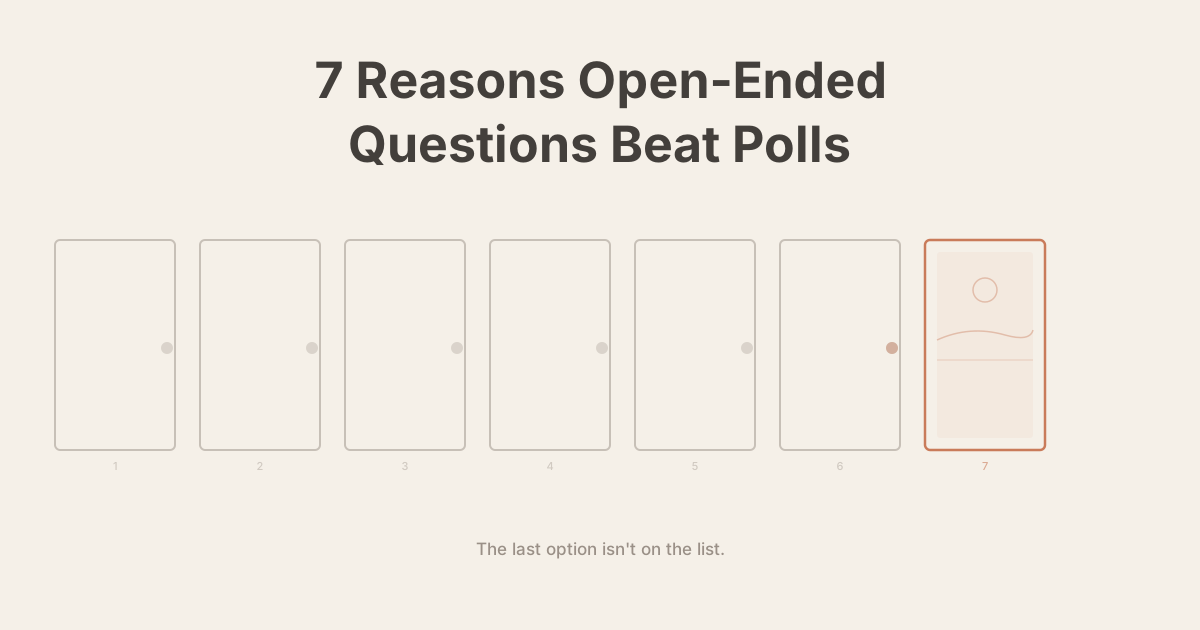
Polls are easier. Open-ended is better. Here's why — specifically enough to act on.
1. You learn what you didn't expect to learn.
A poll confirms or ranks things you already thought of. An open question can surface the thing you'd never have thought to put in a poll — the topic your audience has been waiting for, the confusion that doesn't fit your existing categories, the reason they almost left that you had no idea about.
Discovery is only possible in a format that doesn't predetermine the answer space.
2. You capture the language your audience actually uses.
This is underrated. When fifty people describe the same problem, the specific words they use — their framing, their vocabulary, the analogy they reach for — are more useful than any paraphrase you'd generate internally.
That language is what they'd type into a search engine. It's probably closer to the headline that will perform best. It's the vocabulary that, when you use it in your content, makes people feel seen rather than talked at.
Polls produce category labels you wrote. Open responses produce language your audience actually uses.
3. You hear the reasoning, not just the position.
"Option B" tells you which. "I chose B because I've found that approach consistently works when A has failed me" tells you why, what conditions matter, and what your audience has already tried.
The reasoning is often more useful than the answer. It contains the context that makes the answer interpretable and actionable. Polls strip the reasoning. Open responses include it naturally.
4. You don't lead the witness.
Poll options frame the response before the respondent has finished thinking. Even neutral-seeming options communicate what the pollster considers the plausible range. If the real answer is outside your option space, it doesn't appear in your data.
An open question has no option space. What comes back is what the respondent actually thought, in the frame they actually used.
5. You surface internal disagreement.
When you ask "which of these do you prefer?" you get a majority and a minority, but you don't learn why they differ, or what the minority knows that the majority doesn't.
Open responses often reveal the structure of disagreement: not just that some people prefer one thing over another, but that different audience segments are using the same word to mean different things, or that the minority has experience that changes the calculus. That's information you can act on. A percentage split isn't.
6. Responses compound into an asset.
Responses from open questions are raw material. You can quote them, use them as content seeds, find patterns across them, share them as evidence of what your audience collectively thinks. They have ongoing value beyond the initial analysis.
Poll data tells you percentages at a moment in time. Open response data is a growing archive of how your audience thinks, in their own words, on the questions that matter to your work.
7. The analysis barrier is gone.
The historical argument for polls was practical: open-ended data is hard to analyze. You can't average a paragraph. With hundreds of responses, manual reading was prohibitively slow.
That argument is largely obsolete. Computational approaches to qualitative coding reduce analysis time by 80-98% compared to manual methods. Themes that would take days to extract surface in minutes. The tradeoff between richness and analyzability that justified polls — at the individual creator scale — no longer holds.
The better data is now also the more practical data. The reason to reach for polls instead of open questions has narrowed to the cases where polls are genuinely more appropriate — fast lightweight decisions between known options — not the cases where they're just easier to analyze.
The right tool for the job: use polls for quick decisions between options you've already defined. Use open questions to find out what you don't yet know. They're complementary, not competing — the mistake is using only the easier one.
Tags
Want insights like this for your audience?
Set it on autopilot. One question a week, every response analyzed into insights you can actually use.
Start free — no credit card