Survey Fatigue Is Real: Why Your Audience Ignores 20-Question Forms
Survey requests are up 71% since 2020. Response rates have been falling for years. The problem isn't your subject line.

There's a specific feeling that comes with sending a survey to your audience. You write the questions carefully. You test the link. You write a subject line that makes it sound like this will only take a minute. You hit send to 8,000 people.
Three days later: 47 responses.
You adjust the subject line. Resend to the non-openers. Get eleven more. You do the math and decide the 58 people who responded are probably representative. You publish the findings in your newsletter under the heading "Here's what you told me."
The problem isn't the subject line. It isn't the timing. It isn't even that your audience doesn't care about the topic. It's that somewhere between your intentions and your audience's inbox, the form became the thing — and most people have a deeply conditioned relationship with forms that has nothing to do with you.
How we got here
In 2020, something shifted. Organizations that had been measuring things annually started measuring them quarterly, then monthly. Customer satisfaction surveys multiplied. Post-purchase emails proliferated. "Quick 5-minute check-ins" that weren't five minutes arrived in every inbox.
Survey requests have increased 71% since 2020. The volume didn't come with a proportional increase in the value people got from completing them. Most surveys ask for your time and give nothing back — no results, no acknowledgment, no indication that anything changed because of what you said. The exchange is extractive. Audiences learned this, and they adapted.
Response rates have declined 1-2 percentage points every year since 2019. In some tracked periods, they've dropped faster — from 30% to 18% in six months at organizations that were sending frequently. 70% of people now quit surveys before finishing them. Not from laziness. From accumulated experience of starting things that weren't worth finishing.
By the time your survey lands, you're not competing with indifference to your topic. You're competing with the memory of every other survey that asked for fifteen minutes and returned nothing.
The length problem isn't what you think
The conventional wisdom is that shorter surveys perform better. This is true, but it understates how non-linear the relationship is.
Ten-question surveys achieve 89% completion — you've already lost 1 in 9 respondents by question ten. But here's what the data actually shows: the abandonment isn't evenly distributed across questions. People quit when they hit the moment where the cost of continuing exceeds whatever goodwill they brought in. For some it's question four. For others it's the second matrix grid. For most people, it's around "wait, there are still nine more pages?"
The deeper problem is that length doesn't only affect completion. It affects response quality. The person who's still with you at question fourteen is giving you less than they gave at question two — less thought, less honesty, less of the careful reflection that makes qualitative data useful. You're getting the answers of someone who wants to finish, not someone who wants to help you understand.
You could get 100% completion on a twenty-question survey if you made it mandatory. You'd get worse data than a ten-question survey with 60% completion. More answers doesn't mean better answers.
What breaks with a form
There's a category shift that happens the moment your audience recognizes they've been sent a survey. Expectations collapse, reading slows, careful thought gives way to the mental motion of "what's the fastest way through this." It's not that people are unwilling to tell you what they think. It's that forms trigger a specific behavior pattern — and that behavior is almost never what you were hoping for when you wrote the questions.
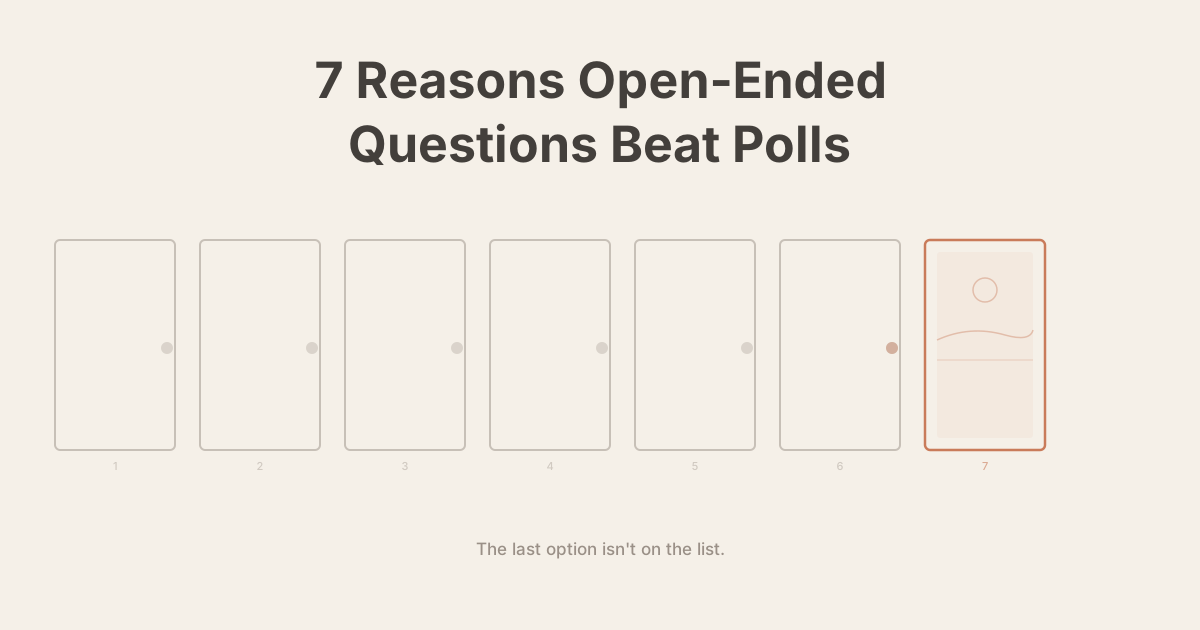
One question sidesteps this. Not because it's shorter in the literal sense, but because it doesn't register as a form at all. A single open-ended question reads like someone asking you something. A single rating scale reads like a form. The format matters more than the length.
This is why "just make the survey shorter" doesn't solve the problem. A five-question survey is still a survey. A one-question ask isn't.
Why one real question outperforms twenty
There's a particular quality to being asked a single, genuine question. You read it and you know there's a person on the other end who actually wanted to know something specific.
What's the one thing you wish I'd cover that I haven't yet?
What almost made you stop reading this newsletter?
What are you working on right now?
These land differently than "Please rate your satisfaction with the following aspects of our content on a scale of 1-5." Not because they're friendlier in tone — it's structural. One question tells the respondent something: you've thought carefully enough about what you want to know that you could narrow it to this. Most surveys signal the opposite — you want everything, and you don't know what matters most.
Email surveys typically achieve response rates of 15-25% when sent to a warm list. Single-question anonymous asks embedded in newsletters or show notes regularly outperform this. Not because the audience is more engaged — because the friction is near zero and the ask feels proportionate to the relationship.
The threshold between "I'll do this" and "I'll close this" is lower than most creators assume. One question clears it. Twenty questions almost never do.
The paradox of asking everything at once
The instinct behind a 20-question survey is understandable. You have a lot of things you want to know. This might be your only chance. You want to be thorough.
But thoroughness at the cost of completion produces data that's comprehensive in scope and thin in substance. You get one-word answers to questions fourteen through twenty from the 30% of respondents still with you by then. You get incomplete data on everything because you tried to gather complete data on too many things.
The alternative — one question, this week, and a different one next week — produces something the comprehensive survey can't: full attention on each question, from a much higher percentage of your audience, over time. By the end of a month you've asked four questions and gotten considered answers to each. By the end of a quarter, twelve questions, all answered by people who weren't exhausted by the time they reached yours.
The data you accumulate isn't just wider. It's richer. Because each question got the response it deserved.
What you're actually asking for
There's something worth sitting with underneath all the completion rate data. When you send a 20-question survey, you're making a specific request: give me twenty minutes of your attention and your honest thinking in exchange for nothing tangible in return.
Most people won't make that trade. Not because they don't value you or your work, but because that's a significant ask and the category "survey" has been cheapened by years of forms that didn't honor the exchange.
When you ask one genuine question — and especially when you close the loop afterward, sharing what you heard and what you're doing with it — you're making a different offer. You're saying: I want to know one specific thing, I've thought carefully enough to narrow it to this, and I'll tell you what I learned.
That's a conversation. Conversations get answered. Surveys get ignored.
The problem isn't your subject line. The problem is the form. The solution isn't a better form — it's a different kind of ask.
Tags
Want insights like this for your audience?
Set it on autopilot. One question a week, every response analyzed into insights you can actually use.
Start free — no credit card